Made by firing
Cream Brick From the Lakeshore Counties
Almost every brick in the world is red because almost every clay has iron in it. This one is not, and the reason is a lake bed full of ground up limestone. It is the one entry in this catalogue where the color of a wall is a chemistry result.
- Which bed or works
- Lake laid clay in the counties along the eastern lakeshore, deposited over limestone country and carrying its dust.
- How it was dressed
- Molded and burned like any other brick of its day. Nothing in the process makes it pale; the clay does that on its own.
- How it got here
- By rail across the state, which is why it appears here in ones and twos, in bands and details, and almost never as a whole wall.
Why a brick is usually red
Iron. Common clays carry iron compounds, and in an oxidizing burn those compounds turn into the reddish oxide everybody recognizes. The more iron and the hotter the burn, the deeper the red, running to a dark plum in a hard fired brick.
So a pale brick is a question. Either the clay has very little iron, or something in the clay is interfering with it.
What the lakeshore clay does
Both, and mostly the second. The clays of the eastern counties were laid down in still water over limestone country, and they carry a large amount of finely ground calcium carbonate along with a moderate amount of iron.
In the burn, the lime reacts with the iron and the silicates instead of leaving the iron free to oxidize on its own. The iron ends up locked into pale compounds rather than in the red oxide, and the fired brick comes out a light cream or buff. The clay is not iron poor. It is lime rich, and the lime wins.
That is the whole mechanism, and it is worth stating carefully because the folk version is that the clay was white. It was not. It fires light out of a clay that looks no more promising than any other.
What it was worth
A great deal, for a while. A pale brick was distinctive at a time when a builder's palette was red, darker red and stone, and it was produced in enormous quantity, so it was available as a catalogue item across a wide region.
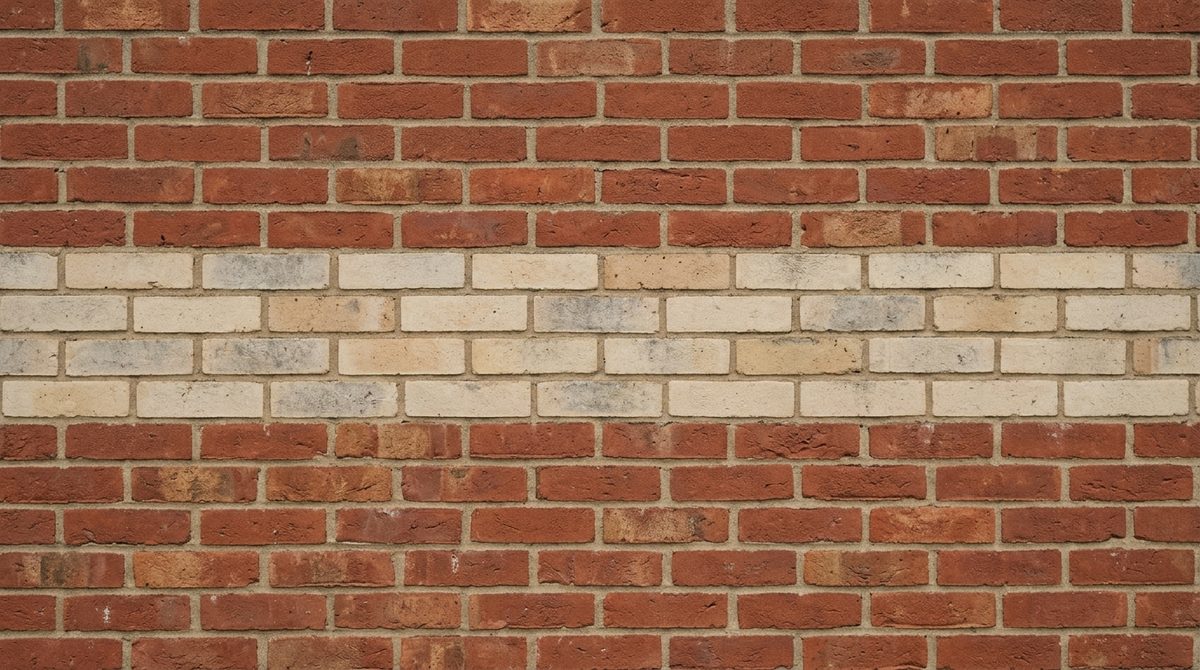
Distinctive and available is a combination that travels. It went out by rail, and it turns up far from where it was made, doing exactly the job a novelty facing material does: bands, quoins, window heads, a stripe at a floor level, an occasional whole front where an owner wanted to be noticed.
Why it is scarce here
Freight, again, and one more thing. This city sits a long way across the state from those yards, and a brick is heavy for its price, so the delivered cost was high relative to a local common brick and to a pressed brick from nearer works.
The other thing is that a pale brick is unforgiving. It shows every stain, and in a place with coal smoke and hard winters that meant a wall that looked poor within a generation unless it was washed. Buff and cream fronts elsewhere darkened badly, and that reputation traveled along with the product.
So it appears in fragments. A course, a head, a panel. Somebody bought a small quantity to make a point, and the point is still there.
One thing this entry does not do
It does not name the city those yards were in, and it does not use the nickname the brick is usually sold under, because the nickname belongs to a particular place and this catalogue is about a different one. The material is described by where the clay was laid down, which is what actually determines its behavior.
Made by firing, one of five ways in the catalogue