Made by casting
Rock Faced Block, Poured on the Ground
The only entry in this catalogue with no quarry, no yard and no freight. Sand, gravel, cement and water arrive separately, and the material becomes itself on the ground where it will stand. Its face imitates a stone, and it is not pretending very hard.
- Which bed or works
- None. Sand and gravel from a local pit, portland cement out of a sack, water from a hose.
- How it was dressed
- Tamped by hand into a cast iron machine, faced by whichever mold plate was bought with it, then cured damp under sacking for a week or two.
- How it got here
- Not carried. That is the entire commercial argument for it, and the reason it appears where it does.
A material with no bed
Every other entry here answers the question of which bed or works it came out of. This one refuses the question, and the refusal is the point.
A concrete block is assembled from ingredients rather than extracted. The gravel and sand come from a pit. The cement comes in a sack from a mill that may be anywhere. Nobody moves a finished heavy unit anywhere, because the finished heavy unit is made where it is used.
For a builder in a city at the working end of a rail line, that arithmetic was decisive. Freight on a heavy material is the largest part of its cost, and this material has essentially none.
The machine
The hand block machine of the first quarter of the twentieth century is a cast iron box with removable face plates and a lever. Damp, stiff mix is shoveled in and tamped hard with a rod, the sides drop away, and a green block is lifted off on a pallet to cure. One person and a boy could make a few hundred in a day on a good day.
These machines were sold by mail, at prices a small builder could reach, and they came with a choice of face plates. Which is where the interesting part starts.
The rock face
The most popular plate was not smooth. It was a rugged, irregular, deliberately quarry looking face, so that the finished block resembled a piece of dressed stone with a pitched surface.
It is worth being clear about what is happening. This is a manufactured unit whose face has been designed to look like the product of a completely different process, one involving a quarry and a stonecutter. There is no deception in it at any level: the blocks are all identical, the pattern repeats every course, and nobody standing in front of such a wall has ever thought it was stone.
What it was really selling was the idea of dressed stone at a price a house could carry. And in that it worked, which is why the material appears in such quantity in the two decades either side of nineteen ten and then stops.
Why it stops
Several reasons at once, and it is honest to say the ordering between them is not settled. Fashion turned against the rock face. Larger plants with power machines took the trade away from the site made block. The mix in a hand tamped block was inconsistent, and blocks made without enough cement or cured too fast in the sun failed in ways that got talked about. And a plain block, once it was cheap and reliable, could simply be covered with something else.
Where it shows
Foundations, small commercial buildings, garages, outbuildings, and the whole exterior of modest houses. It is the material of building without an architect, which is why it is easy to find and rarely written about.
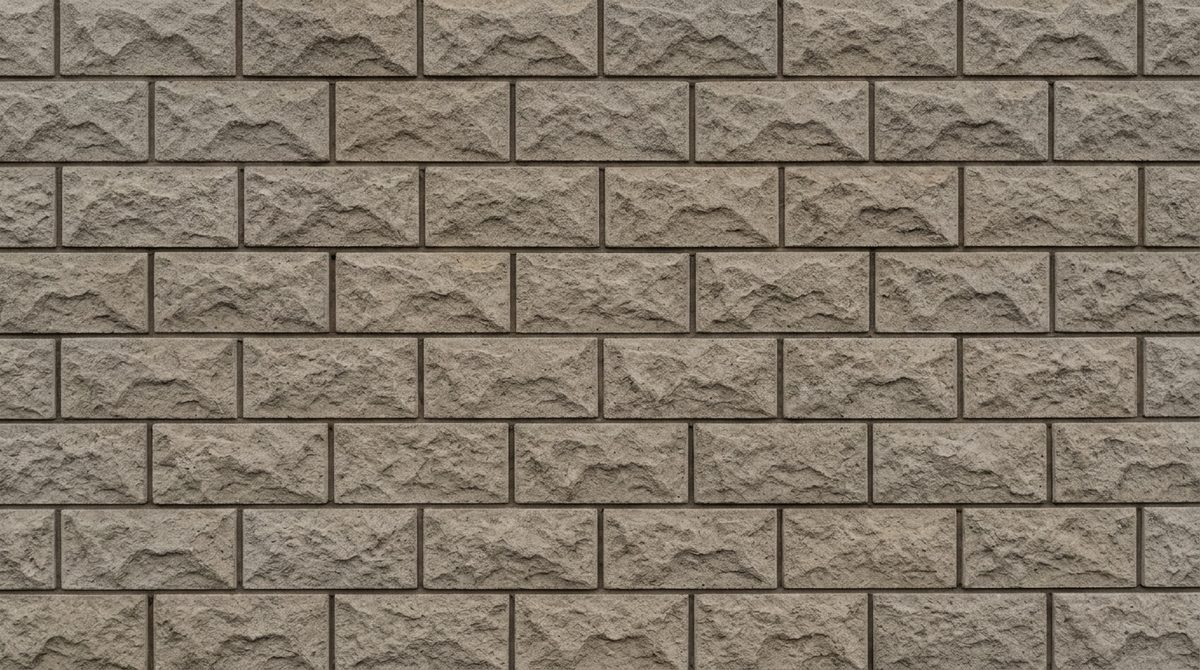
Made by casting, one of five ways in the catalogue